
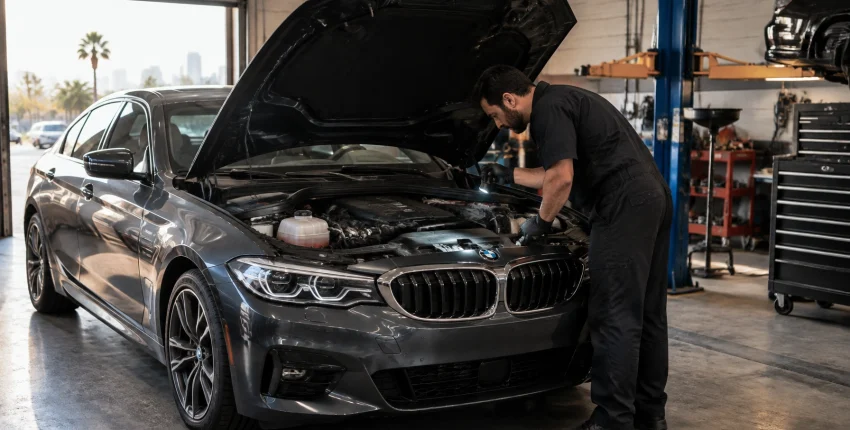
Los Angeles heat puts extra stress on every vehicle, but BMW cooling systems face a particularly demanding combination of high temperatures, turbocharged engines, tightly packaged components, and constant stop-and-go traffic.
A BMW that runs normally on the freeway may begin showing temperature problems while idling on the 101, sitting in traffic on the 405, or climbing through the Valley on a hot afternoon. That does not necessarily mean the entire cooling system has failed. More often, it means one aging component has reached its limit.
The challenge is catching that problem before a small coolant leak or weak water pump becomes an overheating event. A single serious overheat can damage the cylinder head, head gasket, turbocharger, or engine internals.
For drivers who value their vehicles, understanding the common failure points is an important part of luxury car maintenance in Los Angeles.
Why LA Heat and Traffic Are So Hard on BMW Cooling Systems
A BMW cooling system has several jobs. It circulates coolant through the engine, controls operating temperature, removes heat through the radiator, supports cabin heating, and, on many newer models, helps manage turbochargers, transmissions, charge-air systems, and other components.
The basic system includes:
- A water pump to circulate coolant
- A thermostat to control coolant flow
- A radiator to release heat
- An expansion tank to manage coolant volume and pressure
- Hoses, fittings, caps, sensors, and cooling fans
Many of these parts are made partly or entirely from plastic. That does not automatically make them defective. Plastic helps reduce weight and manufacturing complexity. However, repeated heat and pressure cycles eventually cause materials to harden, warp, crack, or lose their ability to seal.
Los Angeles adds several sources of stress:
- High ambient temperatures reduce the radiator’s ability to shed heat.
- Stop-and-go traffic reduces natural airflow through the radiator.
- Extended idling keeps the engine producing heat without the cooling benefit of steady road speed.
- Air-conditioning use adds thermal demand in already hot conditions.
- Turbocharged engines generate additional heat in a tightly packed engine bay.
At highway speed, airflow can temporarily mask a weak fan, restricted radiator, or marginal water pump. In traffic, the system has far less room for error.
The BMW Cooling System Components Most Likely to Fail
Plastic Expansion Tanks
The expansion tank, also called the coolant reservoir, is one of the most common BMW cooling-system failure points.
It holds coolant as the fluid expands and contracts and helps maintain system pressure. Every time the engine reaches operating temperature, the tank is exposed to heat and pressure. When the engine cools, the pressure drops again. Over years of repeated cycling, the plastic can become brittle.
Common signs include:
- Low coolant warnings
- Repeatedly needing to add coolant
- A sweet smell near the engine bay
- Dried white, blue, or colored residue around seams
- Visible cracks near hose connections or the cap
- Coolant dripping near the front of the vehicle
A sealed cooling system should not regularly lose coolant. If the level keeps dropping, topping it off only delays the real repair.
Radiator End Tanks
Many BMW radiators use an aluminum core with plastic end tanks. The aluminum portion may remain functional while the plastic tanks or crimped seams begin to seep.
A radiator end-tank leak may start slowly. You may notice a stain or damp area before seeing an actual puddle. As temperature and pressure rise, the leak can become much worse.
Look for:
- Coolant residue along the side of the radiator
- Fluid collecting beneath the front of the car
- A low coolant warning with no obvious reservoir crack
- A sweet smell after parking
- Temperature changes that appear mainly in heavy traffic
A radiator that is beginning to leak may still cool the engine under light driving. That does not mean it is safe to ignore.
Water Pumps
BMWs use different water-pump designs depending on the engine and model year. Some use mechanical pumps, while many modern BMW engines use electric water pumps.
Electric pumps offer precise electronic control, but their motors, circuit boards, bearings, and internal impellers can wear or fail. A failing pump may not produce a visible leak. It may simply circulate coolant less effectively, or stop circulating it altogether.
Possible warning signs include:
- Rapid temperature increases
- Overheating warnings after idling
- A cooling fan running loudly or constantly
- Reduced engine power
- Whining or grinding noises
- Temperature spikes that improve temporarily once the car is moving
A water-pump failure can progress quickly. If the temperature rises sharply, continuing to drive can turn a manageable repair into major engine damage.
Thermostat Housings
The thermostat regulates coolant flow as the engine warms up. On many BMW engines, the thermostat is integrated with a plastic housing that is exposed to high temperatures and vibration.
The housing can crack, while the thermostat itself can stick open or closed. A thermostat stuck closed can cause overheating because coolant cannot flow through the radiator properly. A thermostat stuck open may cause the engine to run too cool, trigger fault codes, or reduce heating performance.
Warning signs may include:
- A temperature gauge climbing above its normal position
- Temperature fluctuations during city driving
- Heater output that changes unexpectedly
- A coolant leak near the thermostat housing
- Longer-than-usual warm-up times
- An engine warning light or stored thermal-management fault
Because cooling-system layouts vary significantly between BMW platforms, diagnosis should be based on the specific engine rather than a generic parts list. A technical overview of BMW cooling components and circuits is available through this BMW cooling-system reference.

Warning Signs BMW Owners Should Catch Early
Small symptoms often appear before a major failure. Pay attention to changes that seem minor, especially when they occur repeatedly.
1. Low Coolant Messages
A low coolant warning is not a routine reminder. It usually means the system has lost fluid through a leak, faulty cap, damaged hose, or failed component.
If the warning returns after topping off the reservoir, schedule an inspection instead of continuing to refill it.
2. Temperature Spikes in Traffic
A temperature increase that occurs mainly while stopped can point to a cooling fan problem, weak pump, restricted radiator, low coolant level, or thermostat issue.
Your BMW may appear normal once it reaches freeway speed because ram air improves cooling. That temporary improvement should not be mistaken for a solution.
3. Sweet Coolant Smell
A sweet smell after driving often indicates coolant escaping onto a hot engine component. If the smell is inside the cabin, the heater core or related plumbing may also need attention.
Do not wait for visible steam. A leak can remain hidden beneath engine covers or around fittings.
4. Cold or Inconsistent Cabin Heat
The heater depends on hot coolant flowing through the heater core. If the cabin suddenly blows cold air while the engine is warm, the system may have low coolant, trapped air, or a circulation problem.
This symptom is especially concerning when paired with a low coolant warning or temperature fluctuation.
5. Residue Around Plastic Components
Dried coolant often leaves a chalky or colored crust around expansion tanks, hose connections, radiator seams, and thermostat housings. This residue is easy to overlook during a casual inspection, but it can be evidence of a slow leak.
6. Steam or a Temperature Warning
Steam, a temperature warning, or a gauge near the red zone requires immediate action. Safely pull over, shut off the engine, and arrange professional assistance.
Never remove the expansion-tank cap while the engine is hot. The cooling system is pressurized, and boiling coolant can cause severe burns.
Why BMW Cooling Repairs Require Specialist Diagnosis
A cooling-system inspection should involve more than checking the reservoir level. A proper diagnosis may include pressure testing, visual inspection of plastic components and hose connections, checking fan operation, scanning for manufacturer-specific fault codes, and evaluating pump and thermostat performance.
BMW and other European vehicles may also use multiple cooling circuits for turbochargers, transmissions, charge-air systems, or auxiliary radiators. That complexity makes accurate diagnosis important.
This is where working with an experienced European car specialist in Los Angeles can help. The technician should understand the known weak points of the specific engine and recognize whether replacing one failed component is appropriate or whether related parts are already showing signs of age.
Preventive replacement may make sense when several components are approaching the same stage of wear. Replacing a brittle expansion tank while repairing an adjacent cooling component can sometimes prevent a second breakdown later. The correct approach depends on the vehicle’s year, mileage, service history, and inspection results.
Protect Your BMW Before the Next Heat Wave
The best cooling-system repair is the one performed before the car overheats in traffic. Watch for low coolant warnings, temperature changes, sweet smells, residue, inconsistent cabin heat, and unusual fan operation.
If you need BMW repair in North Hollywood, The Auto Lounge provides maintenance, diagnostics, repairs, and specialized care for BMW and other European vehicles. Our team combines more than 30 years of experience with advanced diagnostic equipment and the knowledge required to service both everyday vehicles and high-end performance cars.
Do not wait for a warning to become a breakdown. Contact The Auto Lounge to schedule a cooling-system inspection and find the problem before LA heat turns it into engine damage.